
Handcrafted fragrance is defined as a scent produced in small batches using rare natural ingredients, manual blending techniques, and artisan oversight at every stage of production. This is the industry term: artisanal perfumery. It stands in direct contrast to mass-market fragrance manufacturing, where automation, synthetic substitutes, and volume production keep costs low. Niche and handcrafted fragrances retail between $150 and $400+ per bottle, while mass-market options typically fall between $60 and $150. That gap exists for specific, traceable reasons. Understanding why handcrafted fragrances cost more gives you the tools to evaluate what you are actually buying.
Why do rare natural ingredients drive up handcrafted fragrance pricing?
The single biggest cost driver in artisanal perfumery is raw materials. Handcrafted fragrances allocate 30–40% of retail price to raw materials, compared to just 2–5% for mass-market alternatives. That difference alone explains most of the price gap before a single bottle is filled.
The rarest ingredients carry extraordinary price tags. Natural oud costs $30,000–$50,000 per kilogram, and orris root can reach $80,000 per kilogram. Oud comes from agarwood trees infected with a specific mold, a process that takes decades and cannot be rushed. Orris root requires three years of drying after harvest before it yields usable material. These are not marketing stories. They are supply chain realities that feed directly into the price on the label.
Other costly naturals include:
- Ambergris: A rare substance produced naturally over many years, prized for its warm, marine depth and extraordinary fixative properties.
- Rose absolute: Requires thousands of hand-picked petals to produce a single gram of oil.
- Jasmine sambac: Harvested only at night when fragrance concentration peaks, making labor costs significant.
- Sandalwood: Sustainable sourcing from certified forests adds both cost and ethical credibility.
Mass-market perfumers replace most of these with synthetic molecules. Synthetics are not inherently inferior in scent, but they do not carry the same complexity, evolution on skin, or provenance. An artisan perfumer who uses genuine rose absolute or natural oud is paying a premium that has nowhere to go except into the retail price. The IFRA (International Fragrance Association) sets safety standards for fragrance ingredients globally, and compliance with those standards adds another layer of formulation cost that small producers absorb without the scale advantages of large manufacturers.
Pro Tip: When evaluating a handcrafted fragrance, ask the maker for a full ingredient list. Transparency about sourcing is a reliable signal of genuine artisanal production.
How does small-batch production affect the cost of handmade scents?
Production scale is the second major cost driver. Mass-market brands produce millions of bottles per year, while handcrafted houses often limit runs to 500–5,000 bottles. That volume difference eliminates economies of scale entirely. Every fixed cost, from equipment to rent to the perfumer’s time, gets divided across far fewer units.
The production process itself is more labor-intensive at every step:
- Hand measurement: Each ingredient is weighed individually rather than fed through automated dispensing systems.
- Manual blending: The perfumer combines materials by hand, adjusting ratios based on sensory evaluation rather than a programmed formula.
- Maceration and aging: Handcrafted fragrances often undergo maceration periods lasting months or years, tying up expensive ingredients and slowing inventory turnover. Mass-market production uses accelerated processes that compress this timeline dramatically.
- Hand filling and labeling: Small-batch perfumers perform every step by hand, which introduces slight bottle-to-bottle variation. Connoisseurs read this as authenticity rather than inconsistency.
- Quality inspection: Each bottle receives individual review before it leaves the workshop.
The maceration point deserves particular attention. A fragrance left to mature for six months has its ingredients fully integrated, producing a rounder, more complex scent profile. That six months represents capital tied up in stock that cannot be sold. A small producer with a run of 1,000 bottles cannot absorb that cost the way a multinational can. The price you pay reflects that financial reality directly.
Pro Tip: If a handcrafted fragrance smells noticeably richer after you have worn it for an hour, that is maceration at work. The scent continues to evolve because the ingredients are genuinely complex.
Does artistic freedom add real value to artisan perfume costs?
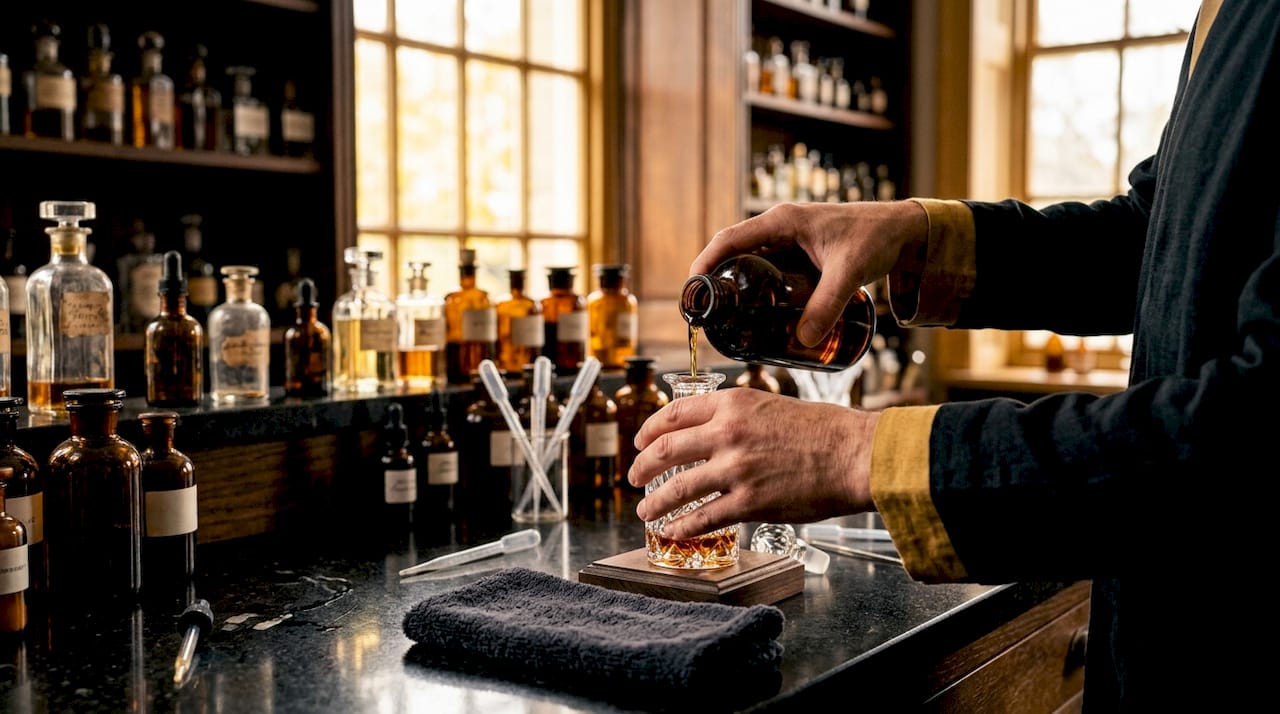
Artisan perfumery rejects the mass-market development model entirely. Mass-market fragrance development starts with consumer research, trend forecasting, and a cost ceiling. The perfumer works backward from a price point. Artisan perfumers start with an idea, a material, or an emotion, and build outward without a predetermined budget.
The high cost of niche perfume reflects a rejection of automation and mass-market shortcuts, involving extensive formula iteration by expert perfumers. A single artisan fragrance may go through 20 to 50 formula versions before the perfumer considers it finished. Each iteration uses real ingredients, real time, and real expertise. None of that development cost appears on a line item, but all of it appears in the final price.
The value drivers in this process include:
- Expert sensory evaluation: A trained perfumer’s nose is the quality control system. No algorithm replicates the judgment call of whether a fragrance is ready.
- Formula complexity: Artisan scents regularly use 30 or more individual ingredients. Mass-market formulas often use far fewer, optimized for cost and shelf stability.
- Iterative refinement: Multiple rounds of testing against real skin, real environments, and real time create a product that performs consistently across conditions.
- Authenticity: Consumers pay a premium for human judgment and artistic integrity that automated processes and focus groups cannot replicate.
The Dorianescents approach to fragrance brand identity reflects this same principle. A scent profile built around a specific emotional experience requires the kind of deliberate creative investment that mass production simply cannot accommodate.
What role does packaging and distribution play in premium fragrance pricing?
Packaging is a cost that buyers often underestimate. Luxury packaging, including crystal bottles and hand-applied accents, can account for 20–30% of a perfume’s retail price. Handcrafted fragrance houses typically use heavy glass, custom stoppers, and hand-finished details that require skilled labor to assemble. The bottle is not decoration. It is a functional container that protects a sensitive product, and the quality of the glass affects how the fragrance ages.
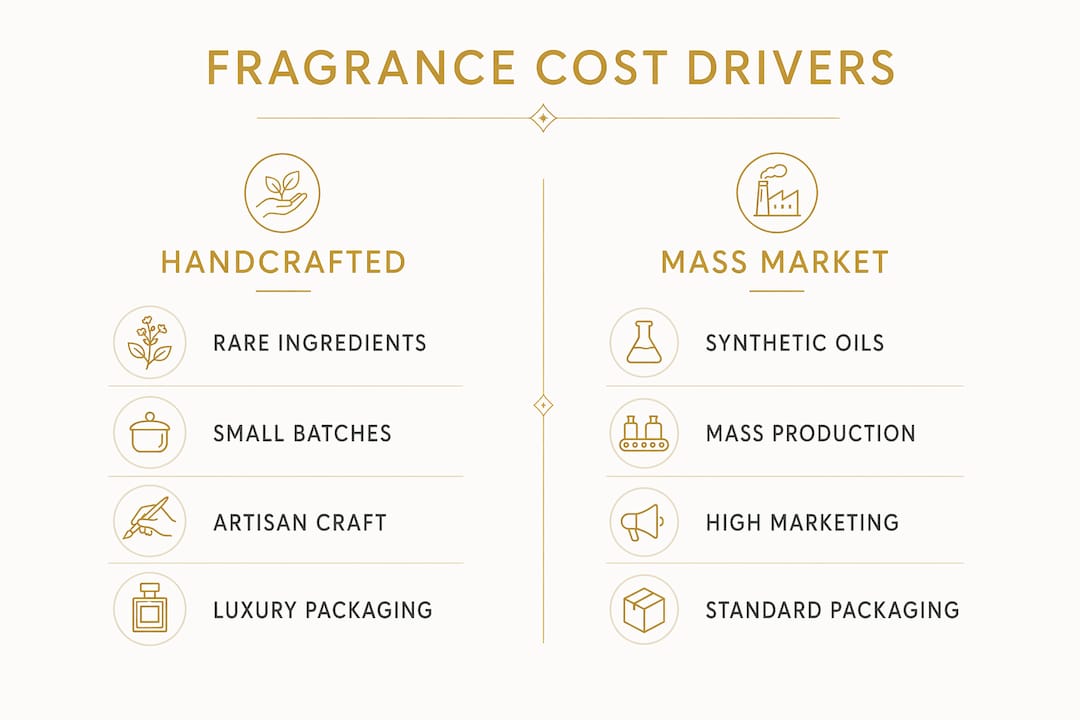
Distribution adds another layer of cost. Limited distribution through boutique retailers and low inventory turnover lead to higher retail margins for handcrafted fragrances. Boutique stockists carry fewer units, turn them over more slowly, and require higher margins to justify shelf space. That cost passes to the consumer.
The contrast with mass-market distribution is stark:
| Factor | Handcrafted fragrance | Mass-market fragrance |
|---|---|---|
| Packaging | Heavy glass, hand-finished details | Standardized, machine-assembled |
| Retail channel | Boutiques, direct-to-consumer | Department stores, supermarkets |
| Marketing spend | Low, word-of-mouth focused | Up to 40% of retail price |
| Batch size | 500–5,000 bottles | Millions of bottles |
| Scarcity effect | Increases perceived and real value | Absent by design |
Mass-market brands spend heavily on advertising to create desire. Artisan producers spend that budget on the product itself. The result is a fragrance where the price reflects what is inside the bottle, not what appeared on a billboard.
Is handcrafted perfume worth the higher price?
The value of a handcrafted fragrance extends beyond the scent itself. Longevity on skin is one measurable benefit. Natural ingredients, properly macerated and blended, interact with skin chemistry in ways that synthetic formulas do not. A well-made artisan fragrance typically lasts longer and evolves through distinct phases, from the opening top notes through the dry-down, rather than fading uniformly.
Artisanal fragrance production is an intentional sustainable practice that minimizes environmental footprint compared to mass synthetic usage. Small-batch producers use fewer petrochemical-derived ingredients, generate less industrial waste, and often source from ethical suppliers. When you buy a handcrafted scent, you are also supporting a supply chain that values environmental accountability.
The scent complexity argument is equally strong. A fragrance built from 30 natural ingredients tells a different olfactory story than one built from six synthetics. The former rewards attention. It changes over hours, responds to your body temperature, and creates a personal experience that no two people wear identically. That uniqueness is a genuine product feature, not a marketing claim.
Pro Tip: Test a handcrafted fragrance on your skin for at least two hours before deciding. The dry-down phase, which appears after 30–60 minutes, reveals the true character of the scent and is where natural ingredients show their depth.
For home fragrance specifically, the same principles apply. A reed diffuser made with natural essential oils releases scent more gradually and consistently than one built on synthetic fragrance oils, and the difference in ambient quality is noticeable within days.
Key takeaways
Handcrafted fragrances cost more because rare natural ingredients, small-batch production, artisan craftsmanship, and premium packaging each add real, traceable costs that mass-market manufacturing eliminates through scale and synthetic substitution.
| Point | Details |
|---|---|
| Ingredient cost | Natural materials like oud and orris root consume 30–40% of retail price in artisan fragrances. |
| Production scale | Runs of 500–5,000 bottles eliminate economies of scale, raising per-unit cost significantly. |
| Artisan craftsmanship | Expert perfumers iterate through dozens of formula versions, adding development cost and quality. |
| Packaging and distribution | Luxury packaging and boutique retail channels add 20–30% to the final price. |
| Sustainability and value | Small-batch natural production delivers longer wear, scent complexity, and lower environmental impact. |
The price is the point
I have spent years around fragrance production, and the question I hear most often is some version of: “Is it really worth it?” My honest answer is that the question itself reveals a misunderstanding of what artisan perfumery is.
Mass-market fragrance pricing is built on marketing budgets and synthetic shortcuts. When you see a celebrity-endorsed bottle at a department store, you are paying for the campaign, not the contents. Artisan pricing works in reverse. The money goes into the ingredients, the time, and the judgment of the person making it. That is not a premium. That is just an honest cost structure.
What I find most compelling is the sustainability argument. Consumers invest in fragrances made with human judgment rather than formula algorithms, and that investment supports a production model that is genuinely better for the environment. Buying artisan is not just a quality choice. It is a values choice.
The slight variation between bottles in a handcrafted run is the detail that convinces me most. A machine does not produce that. A person does. And that person cared enough to do it by hand.
— Steel
Dorianescents: handcrafted home fragrance with nothing hidden
Dorianescents builds every product on the same principles this article describes: rare natural ingredients, small-batch production, and deliberate scent design. Each reed diffuser in the collection is crafted to transform a specific environment, whether that is the calm of a vanilla and sandalwood blend or the clarity of a lemongrass and aquatic profile.
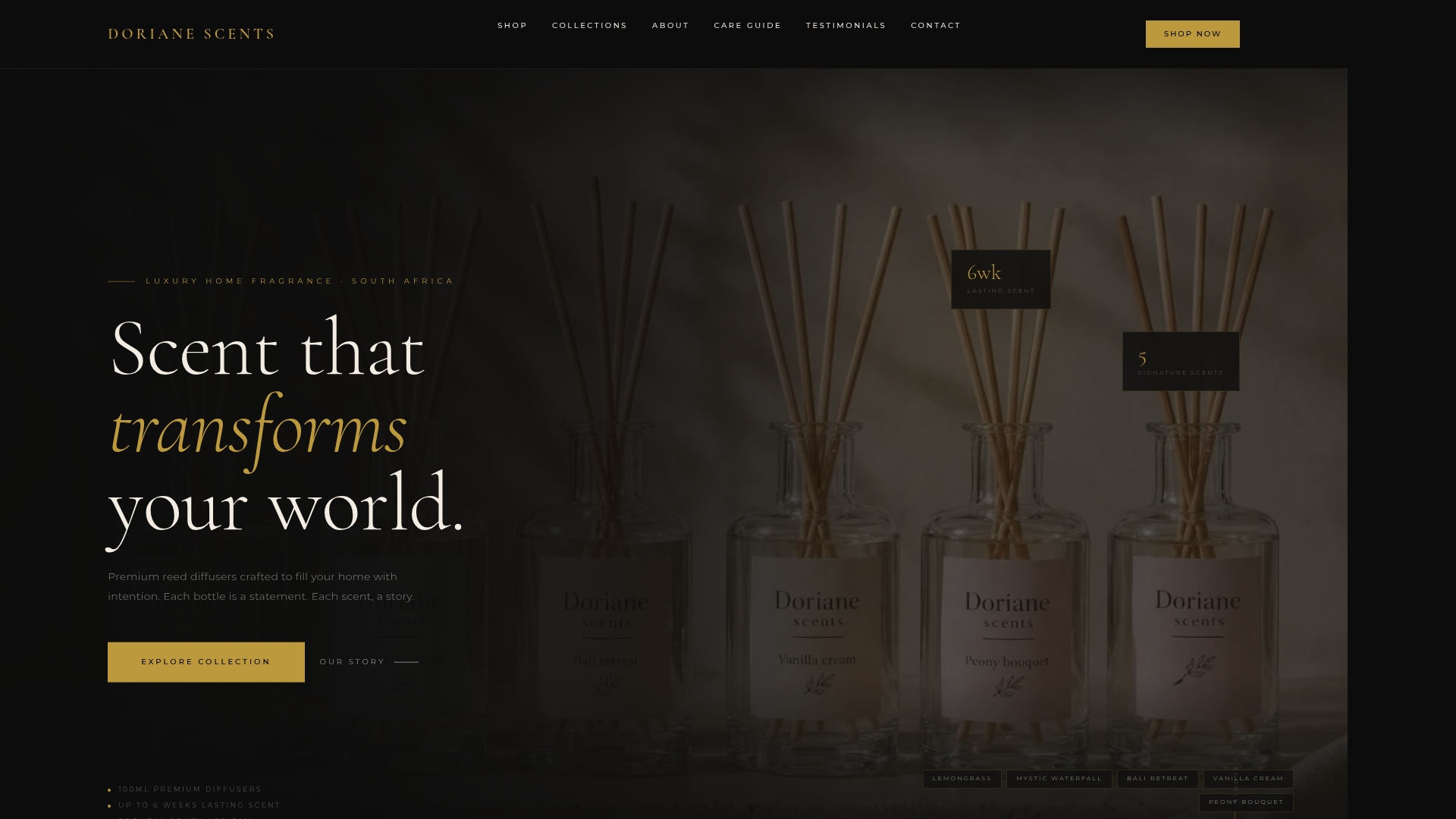
The Dorianescents collections reflect a commitment to ingredient transparency and artisan quality that mass-market home fragrance simply does not offer. If you have read this far and you understand the value behind the price, you are exactly the kind of person these products are made for. Visit Dorianescents to find a scent that fits your space and your standards.
FAQ
Why are handcrafted fragrances so much more expensive?
Handcrafted fragrances use rare natural ingredients that can cost tens of thousands of dollars per kilogram, produced in small batches without the economies of scale that mass-market manufacturers rely on. Every step from blending to bottling is done by hand, which raises the per-unit cost significantly.
What percentage of a handcrafted fragrance’s price goes to ingredients?
Artisan fragrances allocate 30–40% of their retail price to raw materials, compared to just 2–5% for mass-market alternatives. That difference reflects the use of genuine naturals rather than synthetic substitutes.
Do handcrafted fragrances last longer on skin?
Natural ingredients in properly macerated artisan fragrances interact with skin chemistry more deeply than synthetic formulas, typically producing a longer and more complex scent evolution. The dry-down phase of a natural fragrance often reveals layers that synthetic blends do not have.
Is the packaging cost in luxury fragrances justified?
Luxury packaging in handcrafted fragrances serves a functional purpose beyond aesthetics. Heavy glass and quality stoppers protect sensitive natural ingredients from light and air degradation, which preserves the fragrance’s integrity over time.
Are artisan fragrances better for the environment?
Small-batch artisanal production uses fewer petrochemical-derived synthetic ingredients and generates less industrial waste than mass-market manufacturing. Ethical sourcing practices in artisan perfumery also support more sustainable ingredient supply chains.