
Fragrance brand identity is the deliberate creation of a unique sensory signature that embodies a brand’s emotional territory, enabling it to connect with consumers beyond visuals or words. Understanding how fragrance brand identity works means recognizing scent as a strategic asset, not a finishing touch. The global fragrance market is projected to generate approximately US$62.11 billion annually, growing at 3.31% per year. That scale signals a market where differentiation through scent is no longer optional for serious brand builders. Brands like Maison Francis Kurkdjian and Kilian have built entire emotional worlds through scent, and their loyalty numbers reflect it.
How fragrance brand identity works: olfactory positioning explained
Olfactory positioning is the practice of anchoring a fragrance brand around a single, defensible emotional territory. That territory could be comfort, luxury, discovery, or nostalgia. Every note selection, product name, and campaign story flows from that one anchor.
This approach differs sharply from commodity scent branding, where fragrance is chosen to smell pleasant rather than to mean something. Commodity brands compete on price. Brands with clear olfactory positioning compete on feeling, and feeling is far harder to replicate.
“The fragrance industry is shifting toward olfactory positioning, defining a single emotional territory to anchor brand storytelling and product design.” — Momo Advisors
Scent connects directly to the limbic system, the brain region governing emotion and memory. This is why a single whiff of a familiar fragrance can trigger a vivid emotional response within milliseconds. Brands that own a clear emotional territory exploit this pathway deliberately.
Nearly 45% of consumers under 45 see fragrance as a core component of personal expression. That figure means the majority of younger buyers are not shopping for a scent. They are shopping for an identity that matches their own.
Strong olfactory positioning guides every creative decision:
- Emotional anchor: Define one feeling the brand owns (warmth, freedom, refinement).
- Note selection: Choose top, heart, and base notes that reinforce that feeling, not just smell appealing.
- Storytelling: Build campaign language around the emotional world, not the ingredient list.
- Product naming: Use names that evoke the emotional territory rather than describe the scent.
Brands that skip this step produce fragrance lines that smell fine but mean nothing. Consumers move on quickly when there is no emotional reason to stay loyal.
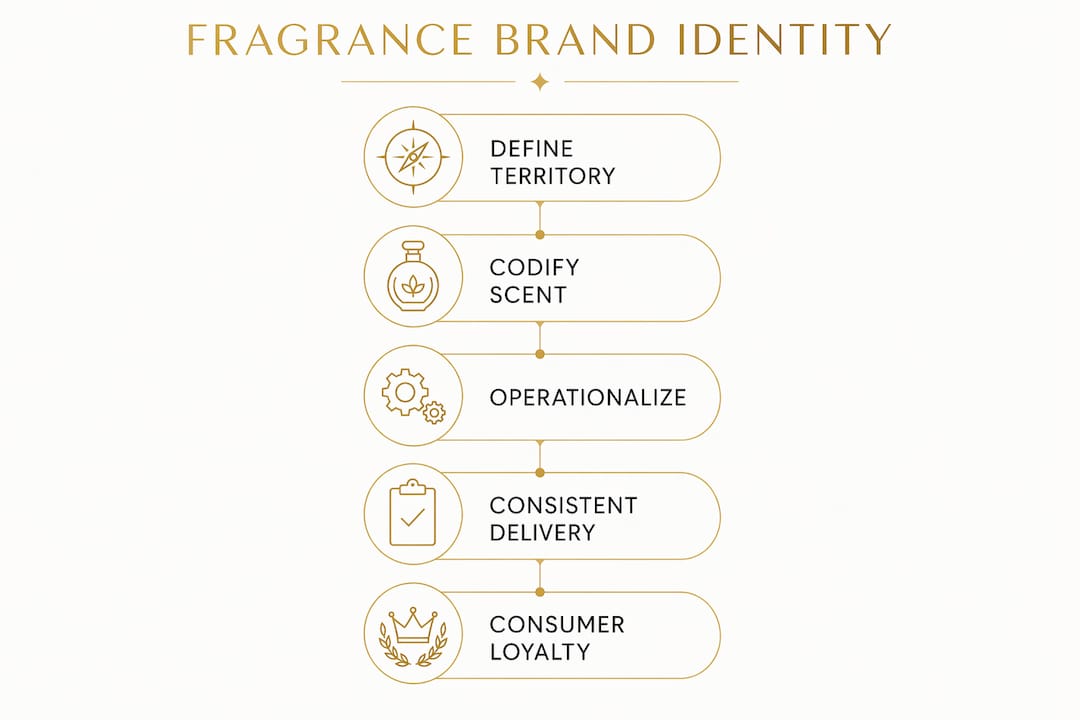
How are fragrance brand identities crafted through artistry and strategy?
Successful fragrance brand identity requires two parallel tracks: creative artistry and operational systems. Neither works without the other. Artistry without systems produces beautiful one-offs that cannot scale. Systems without artistry produce consistent but forgettable products.

Successful fragrance brands integrate artistry with strategy through mood boards, manufacturing sheets, and pricing architecture. These tools preserve brand soul while enabling product launches that reinforce rather than fragment identity. A mood board is not decoration. It is a decision filter that keeps every new product honest to the brand’s emotional territory.
The technical backbone of a scalable scent identity includes several non-negotiable components:
- Signature chord: A core combination of notes that appears across every product in the line, creating immediate brand recognition.
- Sensory descriptors: Written definitions of how the brand should smell, feel, and project, used to brief perfumers and evaluate submissions.
- GC-MS fingerprints: Gas chromatography and mass spectrometry documentation that guarantees scent consistency across batches and markets.
- Allowable variation thresholds: Defined tolerances for ingredient substitution that protect the scent profile when raw materials change.
- Change control processes: Formal approval steps before any formula modification reaches production.
Codifying non-negotiables like preferred structure and sweetness levels creates creative boundaries that protect brand soul while allowing experimentation. This is the difference between a brand that grows coherently and one that fragments with every new launch.
Modular accords allow brands to reuse scent structures across multiple product categories, maintaining a recognizable scent backbone. A reed diffuser, a body lotion, and a room spray can all carry the same brand signature because the core accord travels across formats.
Pro Tip: Write your brand’s scent non-negotiables before briefing any perfumer. List three attributes the brand will always have and three it will never have. This single document prevents months of misdirected development.
What are the most common mistakes in building fragrance brand identity?
The most damaging mistake in fragrance branding is treating scent as marketing decoration. Luxury houses align scent selection tightly with pricing, distribution, and storytelling. Brands that skip this alignment produce sensory experiences that contradict their positioning at every touchpoint.
Common pitfalls include:
- Mistaking chaos for creativity: Launching scents without codified creative boundaries produces a fragmented portfolio. Each product smells different, and the brand loses its sensory signature.
- Choosing descriptive names over world-building names: A name like “Fresh Linen” describes an ingredient. A name like “First Light” builds a world. World-building names drive stronger customer retention because they invite emotional projection.
- Ignoring batch consistency: Scent that varies between production runs destroys consumer trust. Buyers who loved the first bottle will not repurchase a product that smells different.
- Skipping performance KPIs: Scent throw, stability under heat, and longevity on skin or in a room are measurable. Brands that do not track these metrics cannot diagnose quality problems before they reach consumers.
- Neglecting regulatory compliance: IFRA (International Fragrance Association) guidelines govern ingredient safety and concentration limits. Ignoring these creates reformulation crises that disrupt launches and damage credibility.
Pro Tip: Audit your existing fragrance portfolio against your stated emotional territory. If a product does not reinforce that territory, it is either mislabeled or misdirected. Fix the brief, not the formula.
The consequence of poor positioning is not just weak sales. It is brand confusion. Consumers cannot articulate what the brand stands for, and confused consumers do not become loyal ones.
How can brands build and scale a signature scent system?
A scalable fragrance identity system starts with a clear brief and ends with documented technical standards. The steps between those two points are where most brands either build something lasting or create a problem they will spend years correcting.
| Stage | Focus | Key Output |
|---|---|---|
| Brief writing | Emotional and sensory goals | One-page fragrance brief |
| Accord development | Core signature chord | Tested modular accord |
| Portfolio planning | Core, optimized, and limited editions | Tiered product architecture |
| Base engineering | Format-specific adaptation | Diffuser, candle, and lotion variants |
| Compliance review | IFRA and regulatory documentation | Safety and compliance pack |
| Performance testing | Scent throw, stability, batch consistency | KPI baseline and tolerances |
Follow this sequence when building a scent system from scratch:
- Write the fragrance brief. Define the emotional goal, the sensory descriptors, and the three non-negotiables before any perfumer is briefed. A brief without emotional direction produces technically competent but strategically useless submissions.
- Build a signature accord, not a single formula. A signature accord is a reusable scent structure. It can be adapted for different bases without losing the brand’s core identity.
- Plan the portfolio architecture. Core products carry the full signature. Category-optimized products adapt the accord for specific formats. Limited editions introduce new notes while keeping the signature chord intact.
- Engineer for each product base. A fragrance that performs beautifully in a reed diffuser may behave differently in a soy candle or a water-based room spray. Each base requires separate testing and adjustment.
- Document everything. Operational plans including KPIs for scent performance, combined with storytelling frameworks, help brands track physical success and emotional impact simultaneously.
Brands that treat this process as a one-time creative exercise rather than an ongoing system will face reformulation problems, inconsistent consumer experiences, and diluted brand equity over time. The system is the brand.
Key takeaways
Fragrance brand identity works by combining a defined emotional territory, a codified scent system, and consistent technical execution across every product and touchpoint.
| Point | Details |
|---|---|
| Define olfactory positioning first | Anchor the brand to one emotional territory before selecting any notes or briefing perfumers. |
| Codify creative non-negotiables | Document what the brand will always smell like and what it will never include to protect identity across launches. |
| Use modular accords for scale | Build a reusable signature chord that travels across product formats without losing brand recognition. |
| Treat technical standards as brand assets | GC-MS fingerprints and batch tolerances are not administrative tasks. They are what makes a brand’s scent repeatable. |
| Name for emotional worlds, not ingredients | World-building names drive stronger loyalty than descriptive labels because they invite consumer identity projection. |
Why scent systems beat scent moments
The fragrance industry rewards brands that think in systems, not in launches. I have watched brands invest heavily in a beautiful debut fragrance, only to fragment their identity with the second and third products because no one documented what made the first one theirs.
The shift toward olfactory positioning is real, and it is accelerating. Younger consumers, particularly those under 45, treat fragrance as a statement of personal values. They are not buying a pleasant smell. They are buying alignment with a worldview. Brands that have not defined their worldview in scent terms are invisible to this segment, regardless of how good their visual branding is.
The uncomfortable truth is that most fragrance brands skip the technical work because it feels uncreative. GC-MS documentation, change control logs, and batch tolerance thresholds sound like manufacturing problems, not brand problems. They are both. A brand that cannot reproduce its own scent reliably is not a brand. It is a series of accidents.
Dorianescents demonstrates this principle clearly. The brand’s curated scent collections are not random assortments of pleasant fragrances. Each profile, whether vanilla, lemongrass, aquatic, or earthy, reflects a deliberate emotional territory that speaks to a specific mood and lifestyle. That consistency is not accidental. It is the result of treating scent identity as a system.
Codify your non-negotiables. Build your accord. Document your standards. Then let the creativity happen inside those boundaries. That is how brands scale without losing their soul.
— Steel
Discover Dorianescents: scent identity in practice
Dorianescents translates the principles of fragrance brand identity into handcrafted, premium reed diffusers designed for South African homes and gifting occasions. Every scent profile in the Dorianescents collection reflects a deliberate emotional territory, from the grounding warmth of vanilla to the clean clarity of aquatic blends.
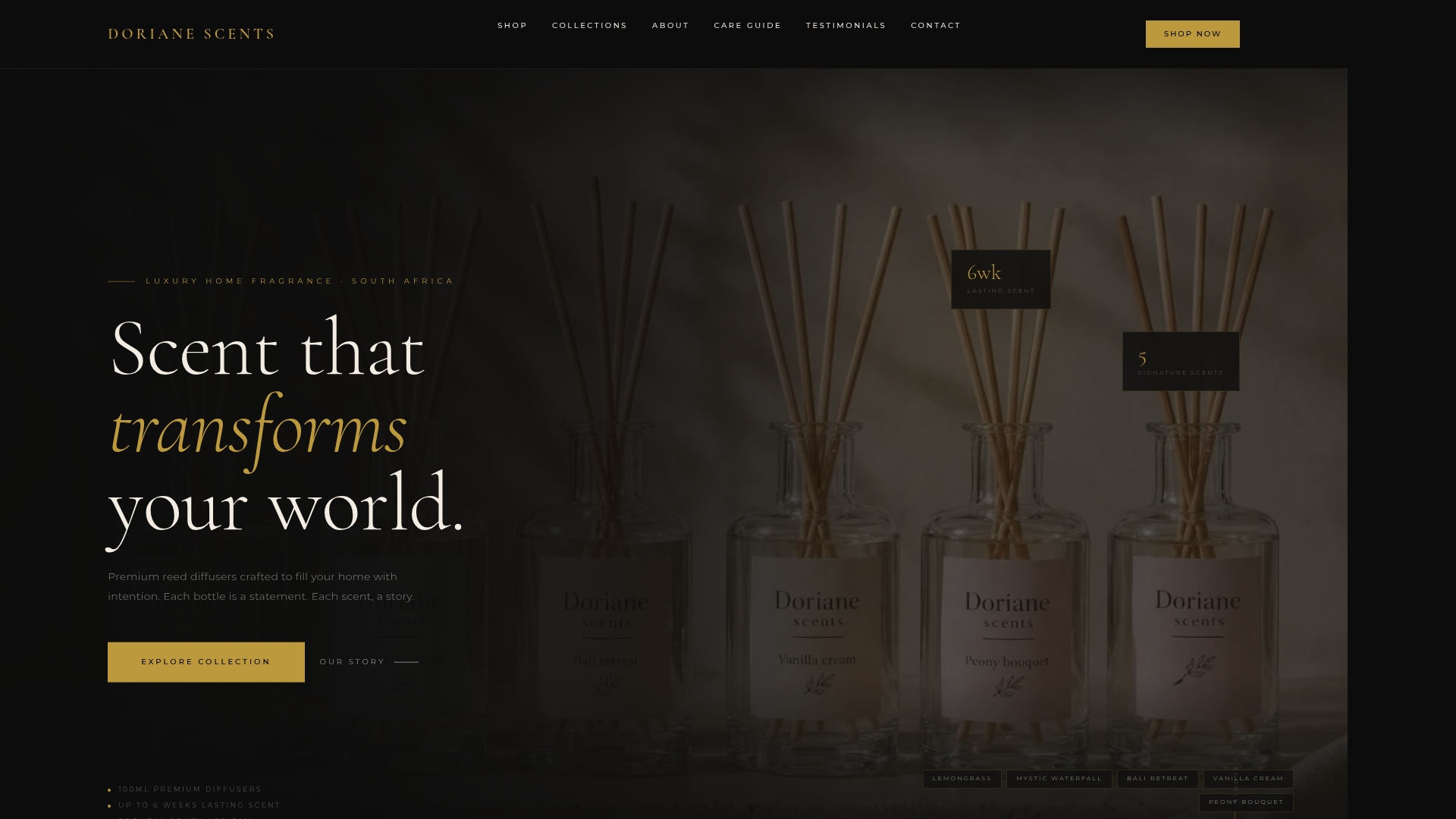
Whether you are building a corporate gifting program or curating a home environment that communicates your personal brand, Dorianescents offers products that carry consistent, codified scent identities. The range includes gift sets and bespoke options for clients who understand that scent is not decoration. It is a statement. Explore the full collection and find the fragrance identity that belongs in your space.
FAQ
What is olfactory positioning in fragrance branding?
Olfactory positioning is the practice of anchoring a fragrance brand to a single emotional territory, such as luxury, comfort, or discovery. Every product, name, and campaign story is built to reinforce that one emotional anchor.
Why does scent consistency matter across product batches?
Inconsistent scent between batches destroys consumer trust and undermines brand identity. Documented GC-MS fingerprints and batch tolerance thresholds are the technical tools that guarantee repeatability.
What is a modular accord and why does it matter?
A modular accord is a reusable core scent structure that can be adapted across different product formats, such as candles, diffusers, and sprays, while keeping the brand’s signature recognizable.
How do fragrance names affect brand loyalty?
World-building names drive stronger customer retention than descriptive labels because they invite emotional projection and build a brand world consumers want to belong to.
What is the first step in building a fragrance brand identity?
The first step is writing a fragrance brief that defines the emotional goal, sensory descriptors, and non-negotiables before any perfumer is engaged. Without this brief, creative development has no strategic direction.