
Fragrance intensity control is the practice of adjusting scent diffusion to create a pleasant aroma without saturating a confined environment. Small rooms between 300–600 sq. ft. reach scent saturation far faster than larger spaces, making deliberate intensity management a necessity rather than a preference. Get it wrong and you face olfactory fatigue within 20 minutes, a condition where your nose stops detecting the scent and you instinctively add more fragrance, creating an overwhelming result. The good news is that a few targeted adjustments to your diffuser settings, reed count, and usage timing solve the problem completely.
How to choose the right diffuser for fragrance intensity control in small spaces
The single most important feature in a small-space diffuser is not output power. Controllability matters more than raw volume, meaning timers, intermittent cycles, and adjustable mist settings outrank any claim about coverage area.
Diffuser types suited for small rooms
Cold air diffusers use pressurized air to atomize fragrance oil without heat, preserving the scent profile and allowing precise output control. A quality cold air unit offers tiered intensity modes with meaningfully different oil consumption rates. At a low setting, a typical atomizer uses roughly 0.15 mL of oil per hour. At high, that rate climbs to 1.2 mL per hour. That is an eightfold difference in scent strength from a single dial adjustment.
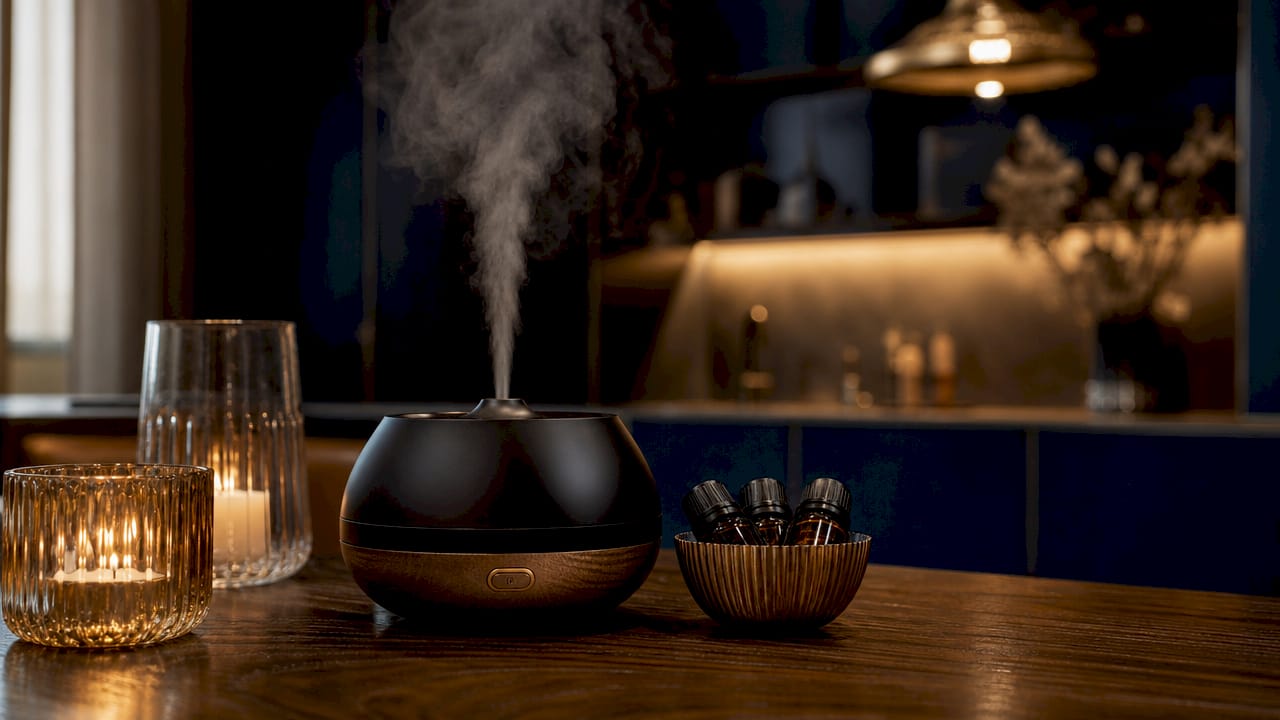
Reed diffusers offer passive, continuous scent release with no electricity required. Their intensity is controlled entirely by reed count. Use 3–4 reeds for subtle scent in a small bedroom or bathroom, and cap at 5–7 reeds before saturation becomes a real risk. Most people underestimate how quickly adding one or two extra reeds intensifies the aroma in a compact room.
Nebulizing diffusers release undiluted oil directly into the air and are generally too powerful for rooms under 400 sq. ft. unless run on the lowest setting for very short sessions.
Scent profiles that work in small areas
Light, fresh notes perform best in compact rooms. Scents like lemongrass, aquatic blends, and clean florals diffuse evenly and feel airy rather than dense. Heavy or resinous profiles such as oud, amber, or deep musks feel oppressive in small spaces because their molecular weight causes them to linger and build up rather than dissipate. Dorianescents offers lighter profiles including lemongrass and aquatic blends that are well suited to apartments and studio rooms.
Diffuser placement for even scent distribution
Placement directly affects how scent moves through a room. Keep your diffuser at least a few feet from walls and fabrics to prevent moisture damage and allow air to carry the fragrance evenly. Avoid tight alcoves or low shelves. A mid-height surface like a side table or open shelf with good air circulation around it gives the best result. For reed diffusers, a spot near a gentle airflow source such as a doorway or a fan on low helps distribute scent without concentrating it in one corner.
| Feature | Why it matters in small spaces |
|---|---|
| Adjustable intensity settings | Prevents scent buildup in low-volume rooms |
| Timer or intermittent cycle | Limits continuous diffusion to avoid olfactory fatigue |
| Low oil consumption mode | Reduces cost and controls saturation risk |
| Reed count adjustment | Allows passive intensity control without new equipment |
| Mid-height placement | Promotes even air distribution and avoids fabric damage |
Step-by-step guide to controlling fragrance strength
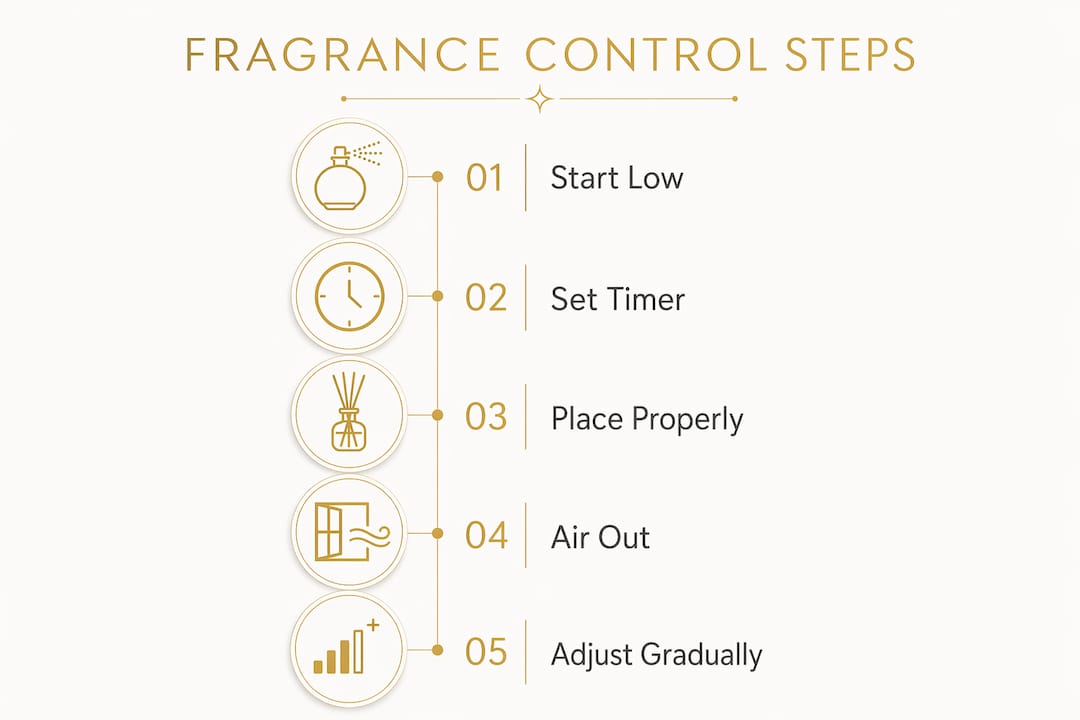
Starting low is the most reliable method for scent management in small spaces. Small rooms saturate quickly, so beginning at the minimum setting or fewest reeds and building up gradually prevents the most common mistake: adding too much fragrance before you realize the room is already saturated.
- Set your diffuser to the lowest intensity. For reed diffusers, start with 3 reeds. For electric diffusers, use the lowest mist or atomization setting.
- Run a 10–15 minute session. Short, controlled diffusion sessions prevent olfactory fatigue and keep the scent pleasant rather than overpowering.
- Leave the room for 5 minutes. This is the re-entry test. Stepping out resets your sensory perception so you can accurately judge the scent level when you return.
- Re-enter and assess. If the scent is barely noticeable, add one reed or increase the setting by one level. If it is clearly present but not sharp, the level is correct.
- Set a timer for intermittent cycles. Running your diffuser for 15 minutes on and 30 minutes off maintains a consistent background scent without buildup.
- Adjust by room type. Bedrooms benefit from the lowest settings, especially at night. Bathrooms need only 2–3 reeds or a single short diffusion burst. Living areas tolerate slightly more, but still benefit from intermittent rather than continuous use.
Pro Tip: If you have been sitting in a room for more than 20 minutes, your nose has adapted to the scent. Always use the re-entry test rather than judging intensity from inside the room. This single habit prevents the majority of fragrance overuse in small spaces.
Common mistakes that cause fragrance issues in small rooms
The most frequent error is running a diffuser on high continuously. A small room has limited air volume, and scent compounds accumulate faster than ventilation can clear them. The result is not a stronger aroma. It is an unpleasant, sharp smell that guests notice immediately and residents stop detecting due to olfactory fatigue.
Olfactory fatigue causes you to misread a saturated room as under-scented. You add more fragrance, the room becomes genuinely overwhelming, and visitors notice what you cannot. The re-entry test is the only reliable way to break this cycle and calibrate your scent level accurately.
Other common mistakes include:
- Ignoring airflow. A room with poor ventilation traps fragrance compounds. Open a window briefly before diffusing to clear stale air first.
- Placing diffusers near fabrics. Curtains, sofas, and rugs absorb fragrance oil and release it unpredictably. This creates uneven scent distribution and can damage fabric over time.
- Flipping all reeds daily. Reed diffusers are designed for slow, passive release. Flipping reeds more than once a week in a small room accelerates oil evaporation and causes rapid intensity spikes.
- Mixing multiple scent sources. A reed diffuser, a candle, and a room spray used simultaneously in a studio apartment create a chaotic scent profile. Choose one primary source per zone.
Signs of olfactory fatigue include a sudden sense that the scent has disappeared, a mild headache, or a feeling that the air is “heavy.” When these occur, ventilate the room fully and wait at least 30 minutes before reassessing. The role of fragrance in room design includes knowing when to pause, not just when to add.
Complementary habits that support scent control in small homes
Effective scent management starts before you open a diffuser. Removing sources of stale odor before introducing fragrance creates a cleaner base and means you need far less scent to achieve a pleasant result. A room that smells neutral requires a fraction of the fragrance intensity that a room with cooking or pet odors needs.
Practical habits that support balanced scent control:
- Ventilate daily. Open windows for 10 minutes each morning to flush stale air. This single habit reduces the amount of fragrance needed throughout the day.
- Manage humidity. High humidity intensifies scent perception. In a bathroom or kitchen, run an extractor fan before diffusing to lower moisture levels.
- Clean surfaces regularly. Dust and fabric fibers trap odor molecules. Regular cleaning means your fragrance works with a neutral base rather than competing with accumulated smells.
- Use scent zoning. Assign one scent profile per area in a small home. A lemongrass blend in the living area and a soft floral in the bedroom creates distinct zones without overlap. Dorianescents’ fragrance zone guide covers this principle in detail.
For short scent bursts without committing to a diffusion session, a fragrance spray or a roll-on applied to a fabric surface works well. These formats give you immediate, temporary scent that fades within 30–60 minutes, which is ideal for a bathroom or entryway. Integrating fragrance into daily rituals this way keeps scent intentional rather than accidental.
Pro Tip: Before starting a new diffusion session, always air out the room for at least 5 minutes. This resets the scent baseline and gives you an accurate starting point, so you never layer fragrance on top of an already-saturated space.
Key takeaways
Fragrance intensity control in small spaces requires starting low, using intermittent diffusion cycles, and relying on the re-entry test to calibrate scent levels accurately.
| Point | Details |
|---|---|
| Start at minimum intensity | Use 3 reeds or the lowest diffuser setting and build up gradually to avoid saturation. |
| Use the re-entry test | Leave the room for 5 minutes and return to judge scent level with a reset nose. |
| Run intermittent cycles | Diffuse for 10–15 minutes on and 30 minutes off to maintain balanced aroma. |
| Match scent weight to room size | Choose light, fresh profiles like lemongrass or aquatic blends for rooms under 600 sq. ft. |
| Place diffusers at mid-height | Keep units away from walls and fabrics to promote even distribution and prevent damage. |
What living with intentional scent in a small space actually teaches you
I spent years assuming more fragrance meant a better-smelling home. The opposite is true in a compact space. The rooms I remember most fondly were scented subtly, where you noticed the aroma only when you first walked in, and then it simply became part of the atmosphere.
The psychological effect of a well-controlled scent in a small room is disproportionately powerful. A faint lemongrass note in a studio apartment signals cleanliness and calm without announcing itself. A heavy resinous blend in the same room signals effort, and not in a good way. Visitors pick up on the difference immediately, even if they cannot name it.
The re-entry test changed how I approach scent entirely. Before I used it, I was constantly adding more fragrance because I had adapted to whatever was already in the room. Once I started stepping out and returning with fresh perception, I realized I had been running my diffuser at three times the necessary intensity. The room smelled better at a third of the output.
My honest advice: treat your diffuser settings the way you treat seasoning in cooking. You can always add more. You cannot take it away once it is in the air.
— Steel
Dorianescents: scent collections built for small-space living
Dorianescents designs its reed diffusers with the kind of considered restraint that small spaces demand. Each product in the full collection is crafted to deliver a consistent, adjustable scent experience, with fragrance profiles ranging from clean lemongrass and aquatic blends to soft florals and earthy notes.

For anyone living in an apartment or compact home, the reed diffuser format is particularly well suited. You control intensity simply by adjusting reed count, with no settings to configure and no electricity required. Dorianescents’ premium reed diffusers are handcrafted in South Africa and packaged to function as both a scent tool and a décor statement. If you are building a scent routine for a small space, the collections page is the right place to start.
FAQ
What is fragrance intensity control in small spaces?
Fragrance intensity control is the practice of adjusting scent output to create a pleasant aroma without saturating a confined room. Small spaces between 300–600 sq. ft. require lower settings and shorter diffusion sessions than larger rooms.
How many reeds should I use in a small room?
Use 3–4 reeds for subtle, balanced scent in a small room. Going above 5–7 reeds risks rapid saturation in spaces under 600 sq. ft.
How do I prevent olfactory fatigue when using a diffuser?
Run your diffuser in 10–15 minute sessions and use the re-entry test: leave the room for 5 minutes, then return to assess the scent level with a reset nose.
What scents work best in small spaces?
Light, fresh profiles such as lemongrass, aquatic blends, and clean florals work best. Heavy or resinous scents like oud and amber build up quickly in compact rooms and feel oppressive rather than pleasant.
Where should I place a diffuser in a small room?
Place your diffuser on a mid-height surface with good air circulation around it, at least a few feet from walls and fabrics. Avoid tight corners, low shelves, and proximity to curtains or upholstery.