
Fragrance accessories for minimalist spaces are scent delivery tools that combine functional diffusion with understated, architectural design. The best options add atmosphere without adding visual noise. In minimalist interiors, where every object earns its place, a reed diffuser or apothecary candle must work as both a scent source and a design object. Dorianescents builds its entire product philosophy around this principle: that scent enhances a room the way light does, shaping mood and spatial perception without demanding attention.
1. What are the best fragrance accessories for minimalist spaces?
The best fragrance accessories for minimalist spaces fall into five distinct categories, each suited to different room sizes, scent intensities, and design goals.
-
Architectural reed diffusers. A single, well-proportioned reed diffuser in a heavy glass or ceramic vessel delivers continuous scent without any visual fuss. Apothecary-style vessels with matte finishes and sparse labeling read as permanent décor, not temporary accessories. Dorianescents’ handcrafted reed diffusers are designed precisely for this role.
-
Smart app-controlled diffusers. Compact plug-in diffusers with app-based intensity controls suit small rooms where scent can quickly become overpowering. Devices in this category can deliver up to 30 days of scent per vial at 6–8 hours of daily use. That kind of longevity reduces the clutter of frequent refills.
-
Minimalist soy or apothecary candles. Clean-burning soy candles in straight-sided glass vessels add warm, ambient scent during specific rituals like evening wind-down or morning coffee. The vessel itself, once the candle is spent, can serve as a storage object. Choose candles with a single dominant note rather than complex blends, which can feel busy in a spare room.
-
HVAC-integrated scenting systems. For open-plan minimalist homes, HVAC scenting integrates fragrance invisibly into the air system, covering up to 1,000 sq.ft. without any visible hardware. This is the most architecturally pure option. The trade-off is cost and installation complexity.
-
Linen sprays and essential oil blends. Linen sprays applied to cushions, curtains, or bedding layer scent without any permanent fixture. They work best as a secondary layer alongside a reed diffuser, not as a standalone solution. Scent layering using multiple delivery methods creates depth without adding visual objects to a room.
2. Scent palette for minimalist interiors: what notes actually work
Scent selection matters as much as accessory choice. Minimalist interiors amplify sensory input, which means a heavy or synthetic fragrance will feel intrusive where a bare room would feel calm.
Design experts group minimalist-compatible scents into three architectural families. The metal family includes neroli and bergamot, which are bright, clean, and slightly cool. The stone family covers vetiver and patchouli, which are earthy and grounding. The wood family brings sandalwood and cedarwood, which are warm and structural. Pairing scents with architectural materials reinforces the visual language of the room.
Fig is one of the most versatile notes for minimalist spaces. It combines verdant, creamy, and woody depth in a single profile, making it balanced and unfussy across living rooms, bedrooms, and entryways alike. Jasmine works similarly when used in a diluted, green-leaning form rather than a heavy floral concentration.
“Minimalist interiors amplify sensory input, so fragrance must soften edges without overpowering or synthetic elements. The goal is scent that feels like it belongs to the architecture, not something added on top of it.”
Avoid synthetic musks, heavy gourmand notes like vanilla-heavy blends, and anything described as “fresh linen” from a synthetic base. These scents tend to read as air freshener rather than considered design. Natural fragrance grounded in real botanical extracts holds better in a spare room because it evolves rather than sitting flat.
3. Design and material considerations for fragrance vessels
The vessel is not packaging. In a minimalist space, the diffuser bottle or candle holder is a permanent resident of the room, and it should be chosen with the same care as a ceramic bowl or a lamp base.
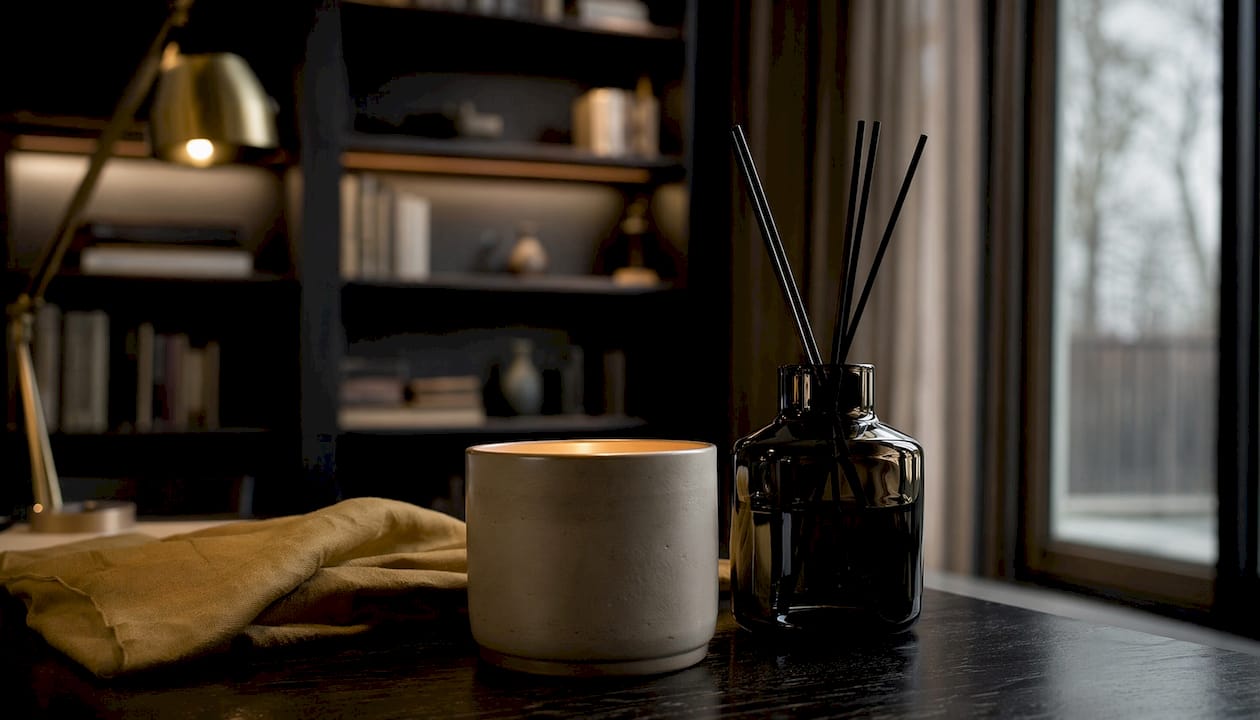
Heavy apothecary-style glass and high-density ceramic both communicate permanence. They sit still visually, which is exactly what a minimalist room needs. Lightweight plastic or brightly labeled bottles undermine the aesthetic immediately, regardless of how good the scent is.
Matte finishes outperform glossy ones in most minimalist settings. Gloss reflects light and draws the eye, while matte recedes into the room. The same logic applies to labeling: sparse typography or no visible label at all is preferable to bold branding. Some vessels are designed to stand alone without reeds or oil, functioning as design objects in their own right.
Refillable vessels reduce disposable clutter over time. A single bottle that you refill every few months is more aligned with minimalist values than a rotation of small, single-use items. UV-protected glass also preserves scent purity by blocking light degradation, which means the fragrance stays true longer.
Pro Tip: Choose one statement vessel per room and resist the urge to add secondary pieces. A single well-chosen diffuser does more for a minimalist space than three smaller ones ever will.
4. Comparing fragrance accessory formats by room and situation
Different rooms call for different formats. The table below maps each accessory type to its best use case in a minimalist home.
| Accessory type | Best room | Scent longevity | Intensity control | Visual footprint |
|---|---|---|---|---|
| Architectural reed diffuser | Entryway, living room | 4–12 weeks | Low (reed count) | Minimal, permanent |
| Smart plug-in diffuser | Small bedroom, bathroom | Up to 30 days per vial | High (app-controlled) | Very small |
| Apothecary soy candle | Bedroom, reading nook | 40–60 hours per candle | Medium (burn time) | Warm, focal |
| HVAC scenting system | Open-plan living, large spaces | Continuous | High (system settings) | Zero visible hardware |
| Linen spray | Closet, bedroom, soft furnishings | Hours per application | High (spray amount) | None |
For a small bathroom, a smart plug-in diffuser with app control is the most practical choice. You can dial the intensity down to avoid the enclosed-space buildup that makes synthetic sprays feel suffocating. For an open-plan living area, HVAC scenting is the only format that covers the volume without requiring multiple visible units. For an entryway, a single architectural reed diffuser in a heavy vessel sets the tone of the home from the first step inside.
The bedroom calls for restraint. A low-intensity candle burned for 30 minutes before sleep, or a linen spray on the pillow, delivers scent at the right moment without running continuously. Fragrance as a daily ritual works best when it is intentional rather than ambient.
5. Pro tips and budget-friendly options for minimalist scenting
Effective minimalist scenting does not require expensive hardware. The principles matter more than the price point.
- Rotate scents seasonally, not weekly. Changing fragrance too often prevents the brain from associating a specific scent with your home. One signature scent per season builds a stronger sensory identity for your space.
- Use linen sprays in hidden spaces. A cedarwood or vetiver spray inside a wardrobe or linen cupboard adds scent without any visible accessory. This is scent layering at its most invisible.
- Match scent to material. Cedar and linen work together because they share a dry, clean quality. Stone-inspired blends like vetiver pair naturally with concrete or tile surfaces. Natural materials and scent reinforce each other when the notes are chosen deliberately.
- Buy one quality piece rather than several budget ones. A single well-made reed diffuser from a brand like Dorianescents will outlast and outperform four cheaper alternatives. The vessel also stays in the room long after the fragrance is spent.
- Decant into a better vessel. If budget is tight, a quality fragrance oil decanted into a simple apothecary bottle with plain reeds achieves the same visual result as a premium product. The affordable luxury approach to home scenting is about editing, not spending.
Pro Tip: Trim reed sticks to two-thirds of their standard length in small rooms. Fewer exposed reeds reduce throw intensity without changing the oil, giving you precise control without buying a new product.
Key takeaways
The most effective fragrance accessories for minimalist spaces combine architectural vessel design with grounding, natural scent profiles, and a single-piece-per-room discipline.
| Point | Details |
|---|---|
| Choose one statement piece | A single architectural diffuser or candle outperforms multiple small accessories in a minimalist room. |
| Match scent to materials | Wood, stone, and metal scent families reinforce the visual language of minimalist interiors. |
| Prioritize vessel design | Matte, apothecary-style glass or ceramic vessels function as permanent décor, not temporary accessories. |
| Control intensity by room size | Use app-controlled diffusers in small rooms and HVAC systems in open-plan spaces to avoid overpowering. |
| Layer scent invisibly | Linen sprays in hidden spaces add depth without adding any visible objects to the room. |
Why restraint is the real skill in minimalist fragrance
I have spent years watching people approach minimalist scenting the wrong way. They buy five small diffusers, place one in every corner, and wonder why the room feels busy. The problem is not the fragrance. The problem is the thinking.
Minimalism in fragrance works exactly like minimalism in furniture. You do not fill the room with options. You choose one thing, and you choose it well. The vessel matters as much as the scent. A heavy glass bottle with a clean profile on a concrete shelf is a design decision. A cluster of colorful jars is noise.
The scents I return to most often in minimalist spaces are the ones that feel like they belong to the building: cedarwood, vetiver, bergamot. They do not announce themselves. They settle into the room and make it feel more like itself. That is the goal. Scent should make a space feel more complete, not more decorated.
The one thing I would tell anyone starting out is this: buy less, but buy with intention. One Dorianescents reed diffuser in the right vessel, placed in the right room, will do more for your home’s atmosphere than a shelf full of impulse purchases. Treat fragrance as an invisible design layer and it will reward you every time you walk through the door.
— Steel
Dorianescents and the minimalist home
Dorianescents was built for exactly this kind of thinking. The brand’s handcrafted reed diffusers are designed to function as both scent sources and design objects, with vessel aesthetics that suit minimalist, design-conscious interiors.

The Dorianescents collection covers scent profiles across wood, floral, aquatic, and earthy families, giving you the range to build a considered scent palette for every room in your home. Each product is crafted in South Africa with premium fragrance oils and packaging that reflects the brand’s commitment to quality over quantity. Whether you are scenting a small apartment or a large open-plan home, the range offers a format and a fragrance to match your space without compromising your aesthetic.
FAQ
What fragrance accessories work best in small minimalist rooms?
Smart plug-in diffusers with app-controlled intensity work best in small rooms because they prevent scent buildup. A compact reed diffuser in a heavy glass vessel is the best passive option for the same setting.
Which scent notes suit minimalist interiors?
Grounding notes like cedarwood, vetiver, bergamot, and fig suit minimalist interiors best. These scents complement architectural materials and avoid the synthetic quality that disrupts a calm, spare room.
How do I scent an open-plan minimalist space without visible hardware?
HVAC-integrated scenting systems cover large open-plan spaces invisibly, with some systems reaching up to 1,000 sq.ft. This is the most architecturally pure option for minimalist homes with sealed air systems.
How many fragrance accessories should I use in one room?
One statement piece per room is the standard for minimalist fragrance decor. Multiple small diffusers create visual clutter and competing scent layers, which undermine the calm that minimalist design is built to create.
Are reed diffusers or candles better for minimalist spaces?
Reed diffusers offer continuous, passive scent delivery and a permanent visual presence, making them the stronger default for minimalist spaces. Candles suit specific rituals like evenings or reading time, where intentional, time-limited scent is the goal.