
The most effective approach to scent pairing across complementary rooms is scent zoning: assigning different but compatible fragrance families to each space, then layering delivery methods to build depth and persistence. Done well, your home tells a coherent olfactory story from the front door to the bedroom. Done poorly, competing scents collide in doorways and leave every room smelling like a department store counter. Here is what actually works:
- Assign scent families by room function, not by what smells nice in isolation.
- Use complementary scent families for physically connected rooms (citrus with woody, floral with aquatic) and allow contrasting profiles only in rooms separated by walls or closed doors.
- Layer diffusion methods: a reed diffuser as your always-on baseline, a candle for active moments, and a room spray for quick refreshes.
- Scale intensity to room size. Larger spaces handle fuller accords; smaller rooms need restraint.
- Avoid burning multiple candles with competing scent families in one open space.
What are the core principles of scent zoning for complementary rooms?
Scent zoning means deliberately assigning each room a fragrance identity that fits how you use the space and how you want to feel in it. The goal is not uniformity. It is a gentle scent gradient that moves from high-impact at the entryway through warm and inviting in the living room to calm and quiet in the bedroom.
Adjacent rooms connected by open doorways need complementary scent families, not identical fragrances. Identical scents across connected rooms flatten the experience. Complementary ones create a sense of intentional design. The scent family harmony chart is a practical starting point:
- Citrus pairs with woody, aquatic, or light floral.
- Woody/earthy pairs with spice, amber, or musk.
- Gourmand pairs with spice, vanilla, or warm amber.
- Floral pairs with citrus, aquatic, or light musk.
- Aquatic/fresh pairs with citrus, green/herbal, or light wood.
Rooms separated by walls or closed doors can host contrasting profiles without olfactory confusion. Your bedroom can be lavender and cedarwood while your living room runs warm amber and tobacco. The wall does the work.
Fragrance labels are broad guides, not rules. The best scent matching relies on personal sensory instinct and your own connection to a scent, beyond what the marketing category says it should be.
How does layering complementary fragrances actually work?
Layering is not about stacking more scent. It is about combining different delivery methods so fragrance has depth and stays present even when your primary source is off. Industry guidance confirms that combining active candles, passive reed diffusers, and quick room sprays produces the most persistent and complex results.
Each method has a distinct role:
- Reed diffusers provide the always-on baseline. They maintain a room’s scent identity around the clock without any effort. Pair one with a complementary note to your candle, not the same note, to add dimension.
- Candles are event-based. Light them when you want to shift the mood or welcome guests. One active candle per open space is the rule; two competing flames in the same room create a muddy, unpleasant result.
- Room sprays deliver an immediate top-note hit that fades within minutes. Use them for a quick refresh before guests arrive or to reset a room’s mood mid-afternoon.
For open-plan spaces, the layering logic shifts slightly. Without walls to contain fragrance, choose one signature scent that suits the overall mood and place it strategically rather than trying to zone within the same open area. A reed diffuser paired with a candle in a complementary family gives you depth without the clash. For closed rooms, you have more freedom to contrast.
Pro Tip: In smaller rooms, reduce run time rather than the number of drops. A diffuser running for 15 minutes in a compact bathroom achieves the same result as a full hour in a large living room, without the sensory overload.

Practical scent combinations and pairing examples by room type
Functional scent zoning assigns specific note profiles to each room based on its purpose. Here is how that translates into real pairings:
| Room | Scent profile | Example notes | Intensity |
|---|---|---|---|
| Entryway | Bright, high-impact top notes | Bergamot, fig, grapefruit | Bold burst |
| Living room | Warm, complex heart notes | Amber, cedarwood, leather, soft vanilla | Moderate, sustained |
| Bedroom | Calming base notes | Lavender, sandalwood, chamomile | Low and gentle |
| Bathroom | Clean, crisp accords | Eucalyptus, lemon, tea tree, aquatic | Light, short bursts |
| Home office | Alerting but grounded | Rosemary, lemon, peppermint, cedarwood | Crisp and light |
For adjacent rooms, the transition matters as much as the individual scents. A living room running warm amber and wood pairs naturally with a hallway that carries a faint cedar note. The cedar bridges both spaces without repeating either fragrance exactly.

Scaling fragrance intensity to room size keeps the whole system balanced. Large open-plan areas tolerate fuller, richer accords when balanced by soft furnishings and rugs. Compact bathrooms need only a light citrus spray or a small reed diffuser; too much scent in a humid, enclosed space turns sharp fast.
Seasonal and time-of-day adjustments add another layer of intention. Warm amber and spice suit cozy evenings; fresh citrus and linen accords work for daytime. In winter, north-facing rooms benefit from warming notes like cinnamon and orange. Swap your living room scent from a linen-citrus blend in the morning to a soft gourmand in the evening and the room feels genuinely different without any furniture moving.
For home fragrance enthusiasts who want to explore fragrance intensity in large spaces, the principle is consistent: match the strength of the accord to the volume of the room, not just the size of the diffuser.
How do you maintain a harmonious scent flow throughout the home?
The biggest mistake in multi-room scenting is treating each room as an isolated project. Scent bleeds through doorways, travels down hallways, and accumulates in open-plan areas. Managing the transitions between spaces is what separates a thoughtfully scented home from one that just smells busy.
Create a gentle gradient, not a series of sharp switches. Moving from a bold bergamot entryway into a warm amber living room feels natural. Moving from bergamot directly into a heavy oriental bedroom scent feels jarring, the olfactory equivalent of walking from a bright lobby into a dark room with no adjustment period.
The “Common Thread” technique solves this. Identify one shared note between adjacent room scents and let it act as a bridge. If your kitchen runs lemon and basil, your living room scent could be basil and cedar. The basil carries across the threshold and the transition feels intentional rather than accidental. This technique is especially useful in open-plan homes where fragrance zones cannot be physically contained.
A few additional guidelines that hold up in practice:
- Never burn multiple candles with competing scent families in one open space. One active candle plus one passive reed diffuser in a complementary family is the right combination.
- Consider allergen sensitivity before committing to a scent. Strong floral or spice notes can trigger reactions in sensitive occupants. Test new scents on a weekend when you can ventilate freely.
- Rotate scents seasonally. A home that smells the same in july as it does in december misses an opportunity to feel alive and responsive to the season.
Pro Tip: Keep a scent journal. Note the fragrance, delivery method, room, time of day, and your reaction after 20 minutes. After a few weeks, patterns emerge: which combinations feel right, which ones fatigue quickly, and which rooms need a lighter hand. It is the fastest way to build a scent architecture that is genuinely yours.
For anyone building a fragrance zone strategy across multiple rooms, the underlying logic is the same whether the space is a home or a venue: scent should support the function of the space, not compete with it. Pair that principle with sensory design thinking and fragrance becomes as deliberate a design choice as lighting or color.
Key Takeaways
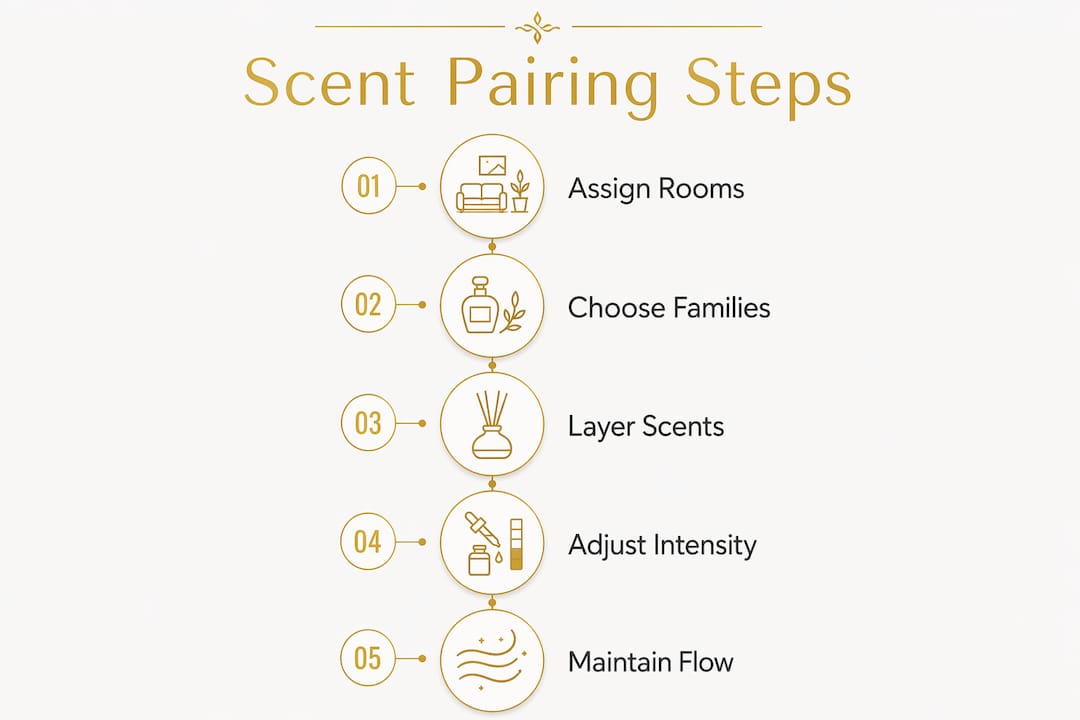
Scent pairing across complementary rooms works best when you assign fragrance families by room function, bridge adjacent spaces with a shared note, and layer delivery methods rather than stacking identical scents.
| Point | Details |
|---|---|
| Assign scent families by function | Entryways need bright top notes; bedrooms need calming base notes like lavender or sandalwood. |
| Use complementary families for connected rooms | Citrus pairs with woody or aquatic; gourmand pairs with vanilla or warm amber. |
| Layer delivery methods | Combine a reed diffuser baseline with a candle for active moments and a spray for quick refreshes. |
| Scale intensity to room size | Larger spaces handle fuller accords; smaller rooms need lighter, shorter diffusion. |
| Bridge transitions with a shared note | One note common to adjacent room scents creates a smooth olfactory transition rather than a jarring switch. |
Dorianescents crafts premium reed diffusers designed with exactly this kind of intentional scent architecture in mind. Whether you are building a citrus-to-woody transition from your entryway to your living room or looking for a calming base note for the bedroom, the Dorianescents fragrance collections give you the building blocks to create a home that smells as considered as it looks.